Few dishes in India inspire as much passionate debate over a single bite as the pani puri. Ask five people where it comes from, and you're likely to get five different answers, delivered with the same conviction reserved for cricket rivalries. But among the many origin stories swirling around this beloved street food, one stands out for being rather more dramatic than the rest. It involves none other than Draupadi, the fiercely intelligent princess of Panchal, from the Mahabharata.
The Legend Of Draupadi And Pani Puri
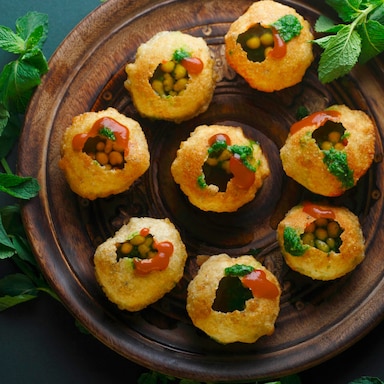
Representative AI Image
According to Amar Chitra Katha, the story goes that during the Pandavas' long years of exile, a newly married Draupadi found herself under quiet scrutiny from Kunti, her mother-in-law. Wanting to test her daughter-in-law's resourcefulness, Kunti handed her the barest of ingredients - the remnants of a potato preparation and just enough wheat dough to roll out a single small chapati. The instruction was that however meagre the means, the five Pandava princes were not to go hungry.
It is precisely the sort of challenge that might have defeated a lesser cook. But Draupadi, the story tells us, was not one to be undone by scarcity. Rather than serving the dough and potato as they were, she divided the small ball of dough into several miniature portions, rolling and frying each into tiny, puffed-up shells, before filling them with the leftover potato mixture. What had begun as barely a mouthful had become enough to feed five hungry princes.
Kunti, the legend continues, was so struck by her daughter-in-law's inventiveness that she is said to have blessed the dish with a kind of immortality - perhaps fitting, given how pani puri remains everybody's favourite, thousands of years on.
The Legend Of Ancient Magadha And Pani Puri
Charming as the Draupadi legend is, historians offer a rather different, and considerably less romantic, account of how the pani puri came to be. This version places its origins in the ancient kingdom of Magadha, a region that today forms part of Bihar. It is believed to have been created during a period that saw a flourishing of salty snacks and farsan across the subcontinent.
Here, the dish's ancestor was known as the phulki, a name that, interestingly, still lingers in certain parts of India as another word for pani puri. These early versions differed from the pani puri we recognise today. The puris were smaller and crisper, though what exactly they were filled with remains a mystery.
Unlike the Mahabharata story, however, there is no single figure credited with the phulki's invention. No name survives in any written record to tell us who first thought to fry a small ball of dough until it puffed into a hollow shell, ready to be filled and eaten in one satisfying bite.
Whether it began as an act of quiet genius in a forest exile, or as a slow culinary evolution in the markets of ancient Magadha, pani puri has long since outgrown its origins, taking on countless regional identities: golgappa in the north, puchka in Kolkata, gup chup in Odisha, and batashe in parts of Uttar Pradesh.