






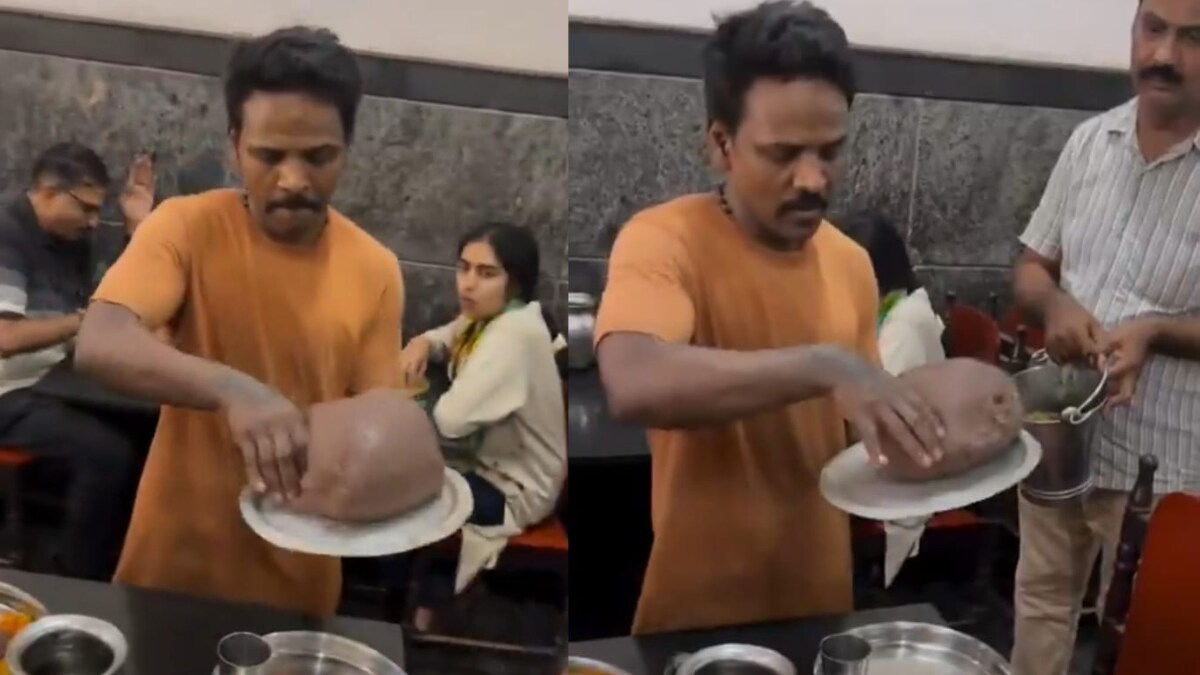
A viral video from a Karnataka restaurant has sparked a heated debate about hygiene preferences, food safety practices and cultural differences. The clip shows a server shaping and serving ragi mudde (like a ball made with ragi) with his bare hands. It drew strong reactions, with viewers debating whether the practice was unhygienic or simply part of a long-standing food tradition. What might have otherwise passed as a routine scene inside a local restaurant suddenly became a part of a wider argument about how food should be handled in the contemporary world.
At the centre of the debate is ragi mudde itself, a staple in many South Indian homes where it is almost always prepared and shaped by hand. For many diners, this tactile process is inseparable from the dish and its texture. Others, however, viewed the clip through the lens of restaurant norms and visible hygiene protocols.
What The Viral Video Shows And How People Reacted Online
The viral video shows a server at a restaurant holding a large portion of ragi mudde on a platter. Using his bare hands, he deftly scoops out a small quantity and quickly transfers the ball-like shape to the plate of a customer. He rotates the portion on his platter (probably to avoid it setting/sticking) before he repeats the action for other waiting customers.
Sharing the clip, one X user wrote, "Somebody saw a ragi ball being served in a way they are not exposed to, and casually called it unhygienic. Five seconds of video shouldn't turn one into a self-appointed expert. This is a food that has nourished generations, built strong bodies, powered farmers, and working families, and that's how it has been served for centuries."
Somebody saw a ragi ball being served in a way they are not exposed to, and casually called it unhygienic.
Five seconds of video shouldn't turn one into self-appointed experts
This is a food that has nourished generations, built strong bodies, powered farmers, and working… pic.twitter.com/CXJAqYYKeD— Karthik Reddy (@bykarthikreddy) December 15, 2025
However, many other people online disagreed with him. They raised hygiene concerns and felt that the dish should be handled with gloves in a commercial setting, like a restaurant (not a home). Read some of the reactions below:
Everything is fine; why can't he put on gloves? These are basic hygienic standards.
All street food vendors and restaurants should be required by Indian municipal or FSSAI officials to follow their hygiene guidelines.— Ramesh J (@RameshJ949979) December 16, 2025
This is unhygienic. I would never want you to eat if someone rubs his entire hand to serve the food I consume. Some traditions needs to change in the fast paced world. It may be a super food but it's almost 2026— Unapologetic Kudi (@unapologetic_kd) December 16, 2025
There's an option of scooping with a steel bowl shaped spoon which is well sanitized too... Why to make a big scene of it? The thing's about hygeine and it needs to be maintained...— Krrsh (@Krrish46459800) December 17, 2025
Just wondering how pizza base is stretched...— Kori (@KORITWEET) December 16, 2025
No one questioned the nutritional quality of the food. Wet, sticky food served with bare hand is just disgusting and unhygienic! He should wear gloves. Wearing gloves in restaurants should be made mandatory.— Bharat Mata Ki Jai 🚩🇮🇳🚩 (@ZeL117343330880) December 15, 2025
Home is diff. Strangers serving like this is diff. I know gloves aren't a solution but, Science has evolved so much but couldn't create a utensil that can carve out a mudde?— Preetam Rao (@Preetam_M_Rao) December 15, 2025
Actually, the first time I saw this dish I thought so too… and I'm South Indian eating South Indian food 99% of the time… but saying it's unhygienic to people who eat it is just plain rude. And social media just makes it more easy for people to be rude.— Fabiola🌻 (@fabwrite) December 16, 2025
Exactly, imagine serving the rice using bare hands in restaurants, will people accept it?
While I do like Raagi Mudde, there can be easily a serving tool made specifically for Raagi Mudde, like a ice cream scoop or something🤔 pic.twitter.com/BoQqZRoRjA— Vije (@vijeshetty) December 16, 2025
Is Wearing Gloves A Foolproof Way Of Maintaining Hygiene?
Gloves are often seen as a quick fix for food hygiene, but many experts and regulators agree they are not a foolproof solution on their own. They point out that gloves can create a false sense of cleanliness. If they are not changed frequently, they can carry bacteria just like bare hands. Touching money, phones, raw ingredients, door handles, or even adjusting hair and masks with gloved hands can contaminate food just as easily. In some cases, improper glove use is considered riskier than clean, well-washed hands if the gloves are not clean.
To all the Glove experts for the Ragi Ball here is a piece of info,
Gloves, at high temperatures (like freshly cooked ragi ball, served hot), soften or degrade, release additives (plasticizers, accelerators) & shed tiny polymer particles due to friction and heat.
Food safety…— Karthik Reddy (@bykarthikreddy) December 16, 2025
Most food safety regulations, including those followed in India, do not mandate gloves at all times. Instead, they emphasise:
- Proper and frequent handwashing
- Clean nails and no open cuts
- Use of gloves or utensils when handling ready-to-eat food, especially if there is a risk of direct hand contact
Regulators and health bodies also stress that gloves must be single-use and task-specific, and changed regularly, especially after handling raw food, touching non-food surfaces, or switching jobs. Gloves can help, but only when used correctly and alongside strict hand hygiene.
Also Read: Multiple Spice Manufacturing Units In Telangana Found Violating Food Safety Regulations
Gloves Vs Bare Hands: Differences In Perception
Even if food safety experts argue that clean hands can be as safe as gloves in certain situations, it remains difficult for many people in India to be comfortable with bare hands touching food. This discomfort is shaped as much by perception as by practice. Over the years, repeated reports of poor hygiene, contaminated street food, and inconsistent enforcement of safety norms have eroded public trust. This has made visible barriers like gloves feel reassuring, even when they are not always used correctly.
Cultural ideas around cleanliness also play a role: while hand-eating is deeply rooted in Indian food traditions, those same hands are expected to be freshly washed and visibly clean. In a restaurant or public setting, where diners cannot see handwashing or hygiene routines behind the scenes, bare-hand contact can trigger doubt and unease. Gloves, hairnets, and other visible signals of hygiene, therefore, help consumers feel protected in a food environment where transparency is often limited.
Also Read: Food Authority Orders Nationwide Testing Of Eggs For Banned Antibiotics
It is important to note that food safety regulations mandate the use of gloves in specific situations, but not in all. It also needs to be complemented by compliance with other hygiene-related rules in order to be truly effective at preventing contamination.