





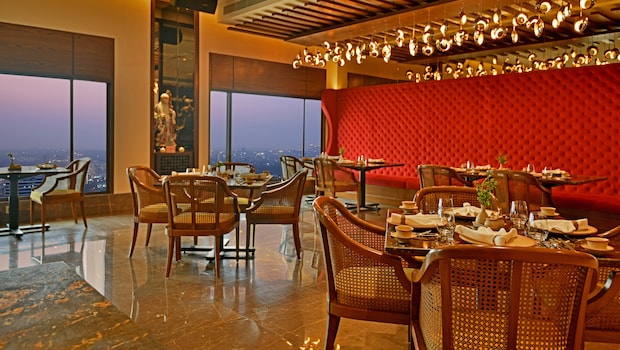
There are dinners you attend because someone important is cooking. And then there are dinners that rearrange something in you, that make you think differently about what food can actually do when it is in the hands of someone who genuinely knows what they are doing. The Chef's Table dinner hosted by Michelin-starred Chef Philipp Dyczek at OKO, The LaLiT New Delhi, on a Thursday evening in early March 2026, was the second kind. It was sold out before most of Delhi had heard about it, which tells you everything about how word travels in fine-dining circles when the right name gets attached to an event.











Also Read: Why Osaka Is Widely Known As The 'Kitchen Of Japan'
The Chef, The Restaurant, The Occasion
Chef Philipp Dyczek runs Artis Restaurant in Graz, Austria. Not just any restaurant: Artis is the only Michelin-starred restaurant in the city, and it earned that star in 2025. Beyond the Michelin, the accolades stack up impressively: three Toques from Gault & Millau, three forks in the Falstaff Restaurant Guide, a spot in the top 50 chefs in Austria, Best Restaurant in Graz at the Schlemmer Atlas, and position 29 in Rolling Pin's top 100 chefs list. This is not someone coasting on one good review. This is a chef who has built a distinctive, disciplined body of work.
Dyczek was joined for the evening by his colleague from Artis, Chef Markus Neuhold. Together, they cooked a menu that reflected what has become Dyczek's signature approach: modern Austrian gastronomy run through a filter of Japanese precision and classical French technique. It is an unusual combination on paper. In practice, as the evening demonstrated, it produces food that is both intellectually interesting and genuinely delicious, which is rarer than it sounds.
The dinner was organised and curated by Ramit Narang of Aperlux Group, with support from Advantage Austria, as a prelude to VINOFEST INDIA: Taste of Austria, a major Austrian wine showcase set to take place at the Austrian Embassy in New Delhi. The event will bring 30 Austrian wineries to India in what is being called one of the most significant Austrian wine delegations ever hosted in this country. That context mattered: the wine pairings across all eight courses were as carefully considered as the food itself, and the evening functioned as something of a masterclass in Austrian varieties that most Indian palates have never encountered.
The room at OKO was full. The guests included H.E. Dr. Robert Zischg, Ambassador of Austria to India, Maria Bruckmayer, First Secretary at the Austrian Embassy, and Hans-Joerg Hoertnagl, Trade Commissioner at Advantage Austria. The institutional support for the evening was visible without being stuffy, and the room had the kind of energy that comes when people genuinely do not know what to expect but are confident it will be worth paying attention.
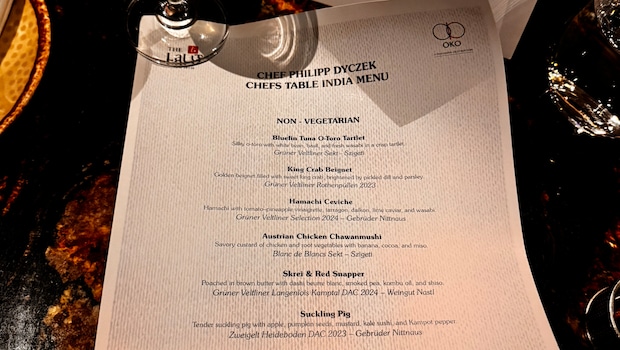
The Menu: All Eight Courses
Course One: Bluefin Tuna O-Toro Tartlet
Paired with: Grüner Veltliner Sekt, Szigeti
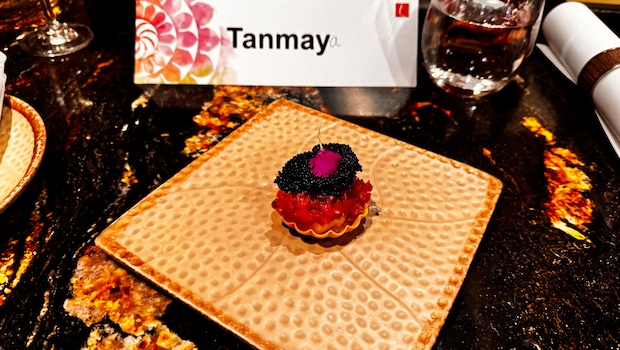
The evening opened with what is arguably the hardest kind of first course to get right: something delicate and luxurious enough to set the tone, without overwhelming a palate that still has seven more courses ahead of it. The Bluefin Tuna O-Toro Tartlet delivered this with quiet confidence. O-Toro, the prized fatty belly cut of bluefin tuna, was layered with white bean and basil in a crisp tartlet shell, with fresh wasabi adding a clean, gentle heat. Nothing overpowered the tuna. The wasabi was there to sharpen rather than distract, and the white bean gave the mouthful a subtle creaminess that made the whole thing feel complete.
The pairing with Grüner Veltliner Sekt from Szigeti was an immediate lesson in Austrian wine. The lively bubbles and bright, citrus-driven acidity cut through the richness of the o-toro, lifting each bite. Several people at the table were asking about the wine before the first course was even finished.
Course Two: King Crab Beignet
Paired with: Grüner Veltliner Rothenpüllen 2023
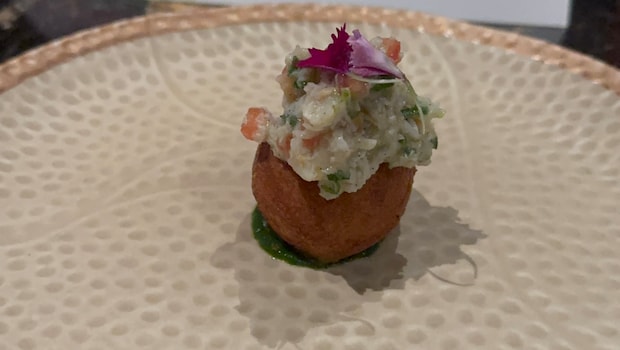
A golden King Crab Beignet followed, accented with pickled dill and parsley. The risk with a beignet is always that the frying process mutes the ingredient inside: you end up tasting batter more than crab. That did not happen here. The crust was light and barely-there, the crab inside was unmistakably sweet and fresh, and the pickled dill added a sharp, herby brightness that stopped the dish from becoming too rich. It was a small course that punched well above its size.
The Grüner Veltliner Rothenpüllen 2023 brought crisp minerality and citrus notes that played off the sweetness of the crab beautifully. Grüner Veltliner, Austria's flagship white grape, has a characteristic combination of freshness, subtle spice, and a clean finish that makes it one of the most food-friendly white wines in the world. This was a good first illustration of that quality.
Course Three: Hamachi Ceviche
Paired with: Grüner Veltliner Selection 2024, Gebrüder Nittnaus
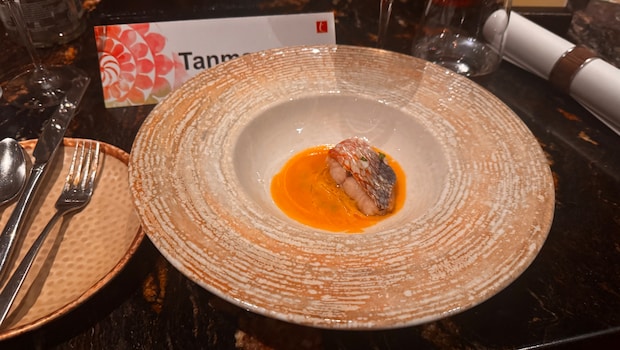
This was the course that most openly signalled the cross-cultural ambition at the heart of Dyczek's cooking. Hamachi, or yellowtail, is a Japanese fish often used in raw preparations. Here it was dressed with a tomato and pineapple vinaigrette, tarragon, daikon, and lime caviar. The tomato-pineapple base is a reference to Peruvian-style ceviche. The tarragon is classically French. The lime caviar, those tiny spheres that burst on the palate, is a very Japanese instinct. And the whole thing came together without feeling like a geography lesson on a plate. It tasted bright, clean, and exciting.
The Grüner Veltliner Selection 2024 from Gebrüder Nittnaus was fresher and more aromatic than the Rothenpüllen, with more of the variety's signature white-pepper complexity on the finish. Against the brightness of the vinaigrette and the herbal quality of the tarragon, it was a very well-judged pairing.
Course Four: Austrian Chicken Chawanmushi
Paired with: Blanc de Blancs Sekt, Szigeti
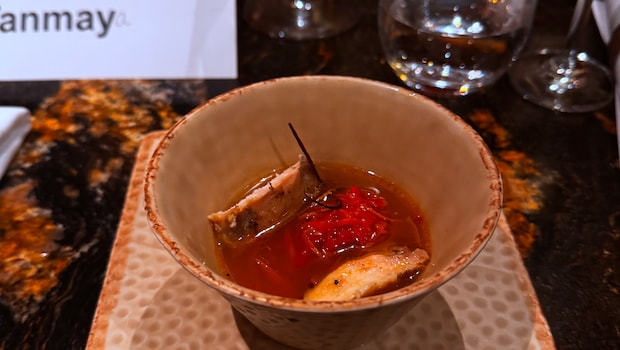
This was the course that generated the most conversation at the table, and for good reason. Chawanmushi is the delicate Japanese savoury egg custard, and it demands a kitchen with both patience and precision: the texture must be silky and barely set, the flavour built gently through dashi and whatever accompaniments surround it. Dyczek's version used chicken and root vegetables as the foundation, then added banana, cocoa, and miso. That combination sounds as though it should not work. It did. The banana contributed a gentle natural sweetness, the cocoa brought a faint earthiness that grounded the dish, and the miso added the deep, savoury umami note that tied everything together. The overall effect was a custard that was unmistakably Japanese in its restraint and texture, but Austrian in its willingness to be rich and layered.
The Blanc de Blancs Sekt from Szigeti was the right call here. A full-bodied still wine would have competed with the delicacy of the custard. The fine bubbles refreshed the palate between bites without disturbing anything the chef had built. This was arguably the best pairing of the evening.
Also Read: Archaeologists Discover A 150-Year-Old Mystery Alcohol Bottle In Utah, Reveal Its Taste
Course Five: Skrei and Red Snapper
Paired with: Grüner Veltliner Langenlois Kamptal DAC 2024, Weingut Nastl
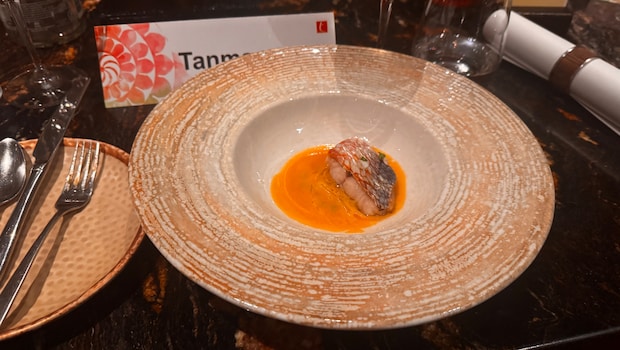
The seafood main arrived, and it was a study in layered umami. Skrei, the highly prized Norwegian migratory cod available only during winter, and Red Snapper were poached together in brown butter, served with dashi beurre blanc, smoked pea, kombu oil, and shiso. The French classical foundation of brown butter and beurre blanc gave the dish structure. The dashi and kombu oil added oceanic depth. The shiso leaf, herbaceous and faintly anise-like, lifted the whole thing with its aromatic freshness. The smoked pea added a quiet sweetness and texture. Every element was purposeful.
The Grüner Veltliner Langenlois Kamptal DAC 2024 from Weingut Nastl was the most structured of the white wines poured during the evening, with a focused acidity that cut through the richness of the brown butter without erasing it. Kamptal is a designated appellation in Lower Austria known for wines of mineral precision, and this one demonstrated exactly that quality.
Course Six: Suckling Pig
Paired with: Zweigelt Heideboden DAC 2023, Gebrüder Nittnaus
The first red wine of the evening arrived alongside the suckling pig, and both were delivered. The pig was tender and beautifully cooked, served with apple, pumpkin seeds, mustard, kale sushi, and Kampot pepper. The apple and pork combination is as Austrian as it gets, a pairing that appears in farmhouse kitchens and Michelin-starred dining rooms across the country in equal measure. The pumpkin seeds added nuttiness and texture. The Kampot pepper, which comes from Cambodia and is prized for its fruity, complex heat, was used with restraint: enough to know it was there, not enough to dominate.
The kale sushi was the most unexpected element, a Japanese form used with a Central European ingredient, and it worked as both a textural contrast and a visual signal of how Dyczek thinks about his food. Zweigelt, Austria's most planted red variety, has a character that is approachable without being simple: ripe dark fruit, gentle spice, silky tannins. The Heideboden DAC 2023 was warm, generous, and just structured enough to hold its own against the richness of the pig.
Course Seven: Duck
Paired with: Blaufränkisch Selection 2022, Gebrüder Nittnaus
The duck course was perhaps the most quietly elegant of the evening. Duck with water spinach, green asparagus, lemongrass, and ginger sounds like it belongs on a Southeast Asian menu, and in a sense it does, but Dyczek handled it in a way that felt completely coherent with everything that came before. The lemongrass and ginger gave the dish a clean, citrus-forward brightness that cut through the fat of the duck. The water spinach added a gentle, leafy earthiness. The green asparagus brought structure and a faint bitterness that balanced the sweetness of the meat.
Blaufränkisch is one of Austria's most interesting red varieties and arguably its most underrated outside of Europe. It has a darker, more tannic character than Zweigelt, with notes of dark berries, herbs, and a cool-climate mineral quality. The Selection 2022 from Gebrüder Nittnaus had the depth to stand up to the richness of the duck while its herbal, spiced profile found natural allies in the lemongrass and ginger. This was the pairing that most suggested the breadth of what Austrian red wine can do.
Dessert: Topfen Soufflé
The evening closed on a note that was both indulgent and elegant. Topfen is Austria's fresh curd cheese, lighter and tangier than cream cheese, and Dyczek used it to make a soufflé that was feather-light and barely sweet. Served with a Riesling sabayon and vanilla ice cream, the dessert had the quality of a very good Austrian patisserie tradition: nothing showy, nothing unnecessary, just beautiful technique and the right ingredients in the right proportions. The Riesling sabayon added a wine-tinged lusciousness that was rich without being heavy, and the vanilla ice cream grounded everything in something comforting. It was the right ending.
What The Evening Said About Austrian Wine In India
The response to the Austrian wines across all eight courses was telling. Grüner Veltliner, Zweigelt, Blaufränkisch: these are not names that most Indian wine lovers can immediately place, but after an evening like this, they should be. The wines were consistently good, consistently food-friendly, and consistently interesting in a way that neither apologised for being unfamiliar nor tried too hard to be impressive. They just worked.
If the enthusiasm at the OKO dinner is any indication, the VINOFEST INDIA showcase at the Austrian Embassy on 28 and 29 March 2026, bringing 30 Austrian wineries to Delhi, has arrived at exactly the right moment in India's evolving wine culture.
Speaking about the successful showcase, Vishal Sharma, General Manager, The LaLiT New Delhi, said: “It was an honour for The LaLiT New Delhi to host Chef Philipp Dyczek and bring his Michelin-starred culinary artistry to OKO. Experiences like these allow our guests to explore global gastronomy at the highest level while reinforcing our commitment to offering exceptional and immersive dining experiences.”
Also Read: Mumbai Foodie Pays Rs 4,200 Baggage Fee To Bring Home Rs 5,000 Worth Of Hyderabadi Biryani
The Final Word
There is a version of a celebrity chef dinner that is about the event more than the food. Tables full of people photographing plates, names being dropped, the actual cooking functioning as background noise for networking. This was not that. Philipp Dyczek and Markus Neuhold cooked eight genuinely considered courses that demanded your attention, earned it, and then kept it. The Austrian wine programme was thoughtful rather than performative. The room at OKO was full of people who had come to eat and ended up learning something. That is the standard for an evening like this, and this one cleared it with room to spare.
OKO, The LaLiT New Delhi | Barakhamba Avenue, Connaught Place, New Delhi