

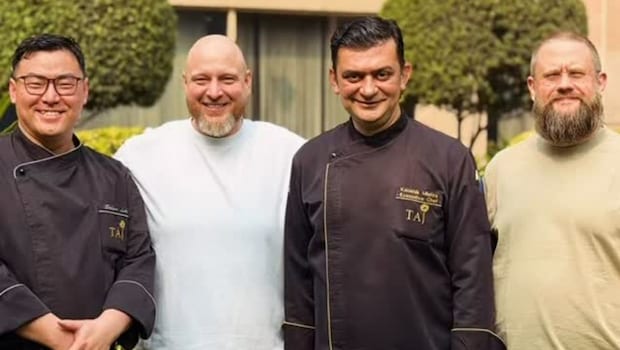
On a cold January afternoon at the iconic Taj Mahal, New Delhi, culinary history unfolded quietly but decisively. Award-winning Danish chef Henrik Jyrk, the visionary behind Copenhagen's celebrated restaurant IBU, brought his signature Nordic sensibility to India for the first time through the latest edition of Rendezvous – The Culinary Chronicles. What made this evening particularly special was not just the chef's reputation or the refined restaurant setting, but the conceptual nature of the menu. This was mindful indulgence at its finest, where technique met curiosity, and European elegance danced with the art of meaningful nourishment.
Also Read: 12 New Restaurants To Visit In Mumbai In 2026
The Prelude: Understanding Sparkling Tea
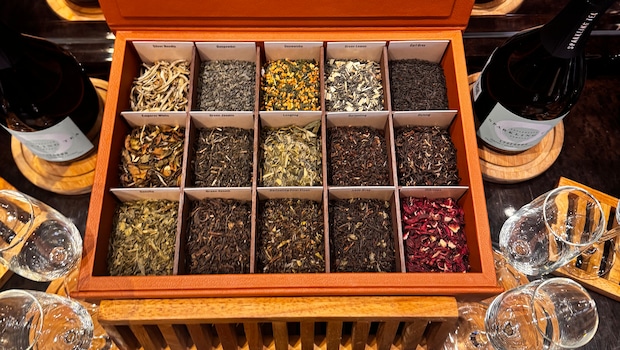
Before the first course arrived, our host, Bo from Copenhagen Sparkling Tea, took centre stage to introduce something most of us had never encountered before. This wasn't the overly sweet, vaguely medicinal "sparkling tea" you might find at a café. Instead, it was a sparkling tea that represents a completely new beverage category, developed by award-winning sommelier Jacob Kocemba and crafted as meticulously as a fine wine.
For an Indian audience accustomed to strict abstainers' options at fine dining establishments, this was revelatory. We were not being offered a compromise; we were being offered a companion beverage of equal stature to any wine.
The Stage: Taj Mahal, New Delhi as Culinary Theatre
The dining room itself struck a balance between understated elegance and intimate warmth. There was no intimidation in the air, no sense of pretence. Instead, what unfolded over the evening was a genuine dialogue between chef and diner, tradition and innovation, Nordic restraint and Indian curiosity.
The Chef: Henrik Jyrk's Journey to Delhi
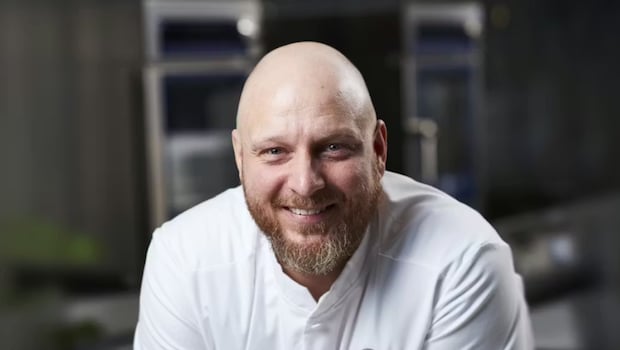
To understand the significance of Chef Henrik Jyrk's presence in Delhi, one must appreciate his trajectory. Originally from Copenhagen, Jyrk has spent his career straddling two culinary worlds: the refined minimalism of Nordic cooking and the vibrant complexity of Asian flavours.
Speaking on his maiden visit to India, Chef Jyrk reflected: "My journey as a chef has been shaped by the flavours I've encountered along the way, from Nordic traditions to the Asian influences that continue to inspire my cooking. Food, for me, is about exchange and curiosity. Rendezvous – The Culinary Chronicles offers a meaningful platform to share this approach, and presenting my cuisine at the iconic Taj Mahal, New Delhi is particularly special. I'm excited to bring my work to India, and just as importantly, to experience Indian flavours and carry those influences back with me.”
The Menu: A Five-Course Journey
The evening presented both vegetarian and non-vegetarian menus, each comprising five courses, each paired with either sparkling tea or a full-bodied wine. What distinguished this menu was its refusal to be merely exotic or showy. Every dish served a purpose within the overall narrative of the evening.
Course One: Scallop with Ginger & Caviar (Non-Vegetarian) / Daikon with Ginger & Caviar (Vegetarian)
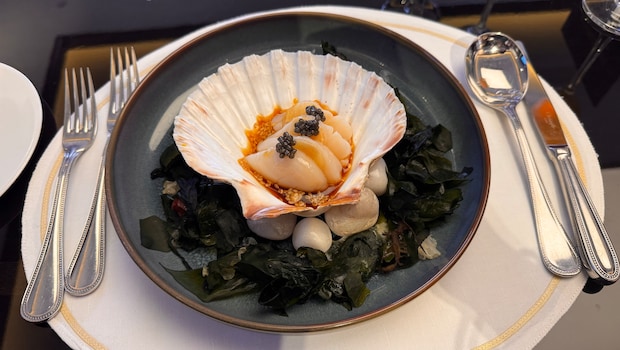
The meal opened with raw scallop, delicately presented with candied ginger and a whisper of caviar. The tea pairing was immediate and intuitive. The tea's herbal undertones and subtle hibiscus complexity cleansed the palate between bites, whilst its subtle acidity harmonised beautifully with the brininess of the caviar. The ginger provided a warming counterpoint, creating a three-way conversation between raw seafood, spiced vegetable, and sparkling tea.
For vegetarian diners, daikon provided an unexpected hero. Often relegated to sidekick status in Asian cuisine, here it was treated with profound respect. Paper-thin slices offered textural complexity reminiscent of the scallop's delicate flesh. The same ginger and caviar garnish created parity between both versions, demonstrating that vegetarian dining need not be an afterthought but rather a parallel expression of the same creative vision.
Course Two: Lobster with Tomato & Vadouvan (Non-Vegetarian) / Tomato, Tomato, Tomato (Vegetarian)
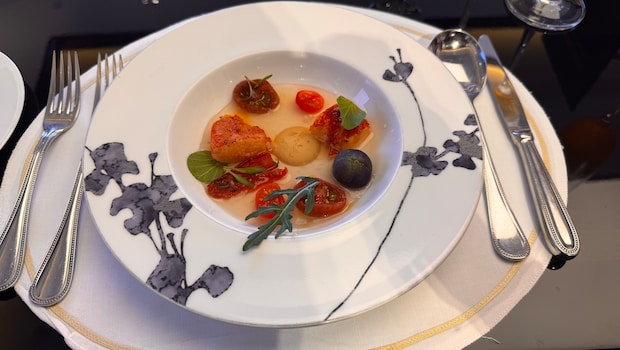
The second course elevated the stakes. The non-vegetarian option featured lobster, that most luxurious of crustaceans, paired with tomato and vadouvan. Vadouvan, for those unfamiliar, is a French-style curry powder with garlic, shallots, and warming spices. Here, it was not deployed aggressively but as a whispered suggestion, a reminder of how Northern European and Indian culinary traditions might speak the same language.
But the real revelation was the vegetarian course: "Tomato, Tomato, Tomato." Three distinct preparations of tomato sat before us. One was a concentrated tomato water, nearly transparent. Another was a roasted tomato emulsion. The third was perhaps a tomato leather or gel. All were paired with the wine pairing: Chateau Mont Redon, a refined Côtes du Rhône Blanc.
This dish embodied Chef Jyrk's philosophy perfectly. Rather than dismissing tomato as ordinary, he asked: what if we interrogate this ingredient with scientific precision and creative playfulness? What hidden facets does familiarity obscure? It's the kind of plate that would have seemed pretentious in less capable hands but felt genuinely inquisitive here.
Course Three: Langoustine with Jerusalem Artichoke & Coconut (Non-Vegetarian) / Jerusalem Artichoke, Coconut & Truffle (Vegetarian)
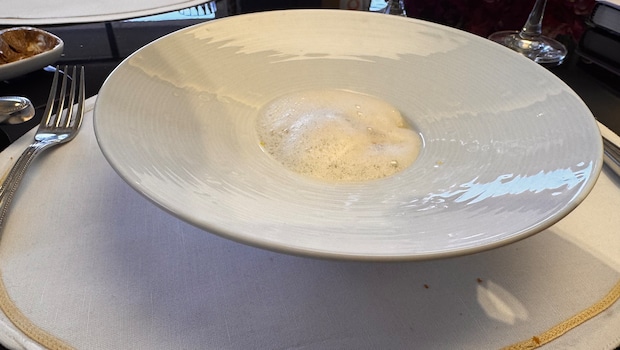
Langoustine, the delicate Scandinavian cousin of the prawn, took centre stage in the third course. The tuber known as Jerusalem artichoke (which, despite its name, is neither from Jerusalem nor an artichoke, but rather a knobby North American root vegetable) provided earthy sweetness. Coconut, that ingredient so familiar to Indian kitchens, was treated here with restraint. It wasn't about coconut milk's richness but rather coconut's subtle fragrances and umami undertones.
The vegetarian version substituted langoustine with additional focus on the supporting players, adding truffle for depth and luxuriousness. Paired with Jacky Marteau Sauvignon Blanc from the Loire Valley, this course demonstrated how Chef Jyrk thinks about balance: each element neither overshadowing nor diminishing the others, but rather creating a complete thought.
Course Four: Nordic Curry with Goat & Peas (Non-Vegetarian) / Nordic Curry with Potato & Peas (Vegetarian)
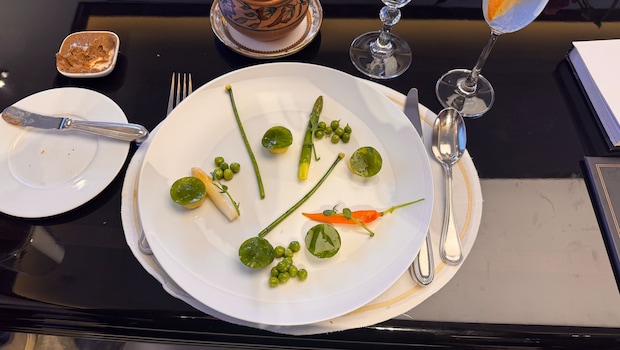
Here, the chef's playfulness became most apparent. A curry, that most Indian of dishes, interpreted through a Nordic lens. The base was likely built on stock and spices rather than the coconut milk that defines so many Indian preparations. Goat meat, lean and slightly gamey, offered textural contrast. Peas provided colour and textural brightness.
Yet what could have felt gimmicky was instead deeply thoughtful. The curry spoke to a genuine truth: both Indian and Scandinavian kitchens have long traditions of slow-cooked meat dishes infused with warming spices. Both cultures understand how to extract profound flavour from humble ingredients. By reimagining a curry through Nordic sensibilities, Chef Jyrk wasn't appropriating or simplifying; he was acknowledging kinship.
Also Read: How To Make Gravy-Style Gobhi Ki Gujiya At Home
The pairing shifted to Grimaldi Barolo, a robust Italian wine that somehow harmonised with both the meat course and the more delicate potato version.
Course Five: Dark Berries & Vanilla Ice Cream
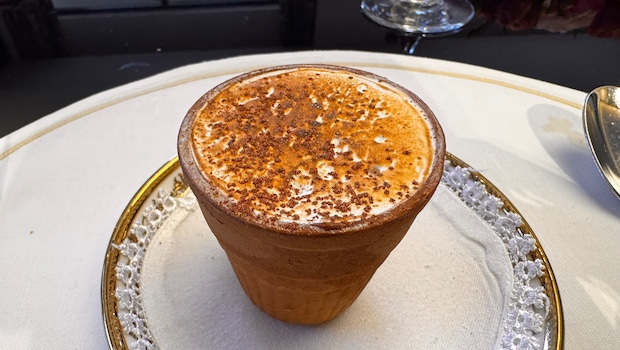
Dessert is where Chef Jyrk truly showed his hand with simplicity. Dark berries, whether blackberries, blackcurrants, or proprietary Scandinavian varieties, were balanced against vanilla's creamy sweetness. The pairing this time being a fresh berry juice with subtle sweetness and tart notes became the meal's emotional resolution, sweet but never cloying, complex but never confusing.
The Broader Narrative: Why This Moment Matters
This event arrives at a particular juncture in India's culinary evolution. For decades, fine dining in India meant either classical French technique or elevated Indian cuisine. The space for genuine fusion, for chefs engaging across traditions with intellectual curiosity rather than commercial calculation, has only recently expanded.
What Chef Henrik Jyrk brought to Delhi was not a revolutionary menu. His technical innovations exist within well-established modernist frameworks. But what was revolutionary was the philosophical approach: a willingness to honour both Nordic and Asian culinary traditions as legitimate sources of inspiration, neither subordinate to the other.
Also Read: Banana vs Banana Milkshake: Which Is Better For Your Gut?
Rendezvous
The evening concluded not with fanfare but with quiet satisfaction. As we departed Taj Mahal into a cool Delhi evening, what lingered was not a sense of having consumed something exclusive or rarified, but rather of having participated in a genuine culinary conversation. Chef Henrik Jyrk had come to India not as a missionary spreading Nordic enlightenment but as a curious traveller seeking exchange. His menu proved that minimalism and maximalism need not be opposed; that vegetarian and non-vegetarian dining can be equal; and that the most sophisticated beverage pairings need not contain alcohol. For those seeking the future of fine dining in India, this evening provided a glimpse: it's conversational, inclusive, and fundamentally curious about the world beyond its own borders.