




As early summer approaches and the first hints of mango season begin to appear, it's natural for conversations to drift towards the country's favourite fruit. Soon, markets will fill with familiar varieties, each with its own loyal following. But every so often, a lesser‑known mango captures public attention - not for its availability, but for its rarity. Industrialist Harsh Goenka sparked curiosity after he shared a post about one such mango from West Bengal: the Kohitur.
Also Read: Food Authority Seizes Fungus-Laden Khoya In Jhansi, Dumps Adulterated Paneer In Noida Ahead Of Holi
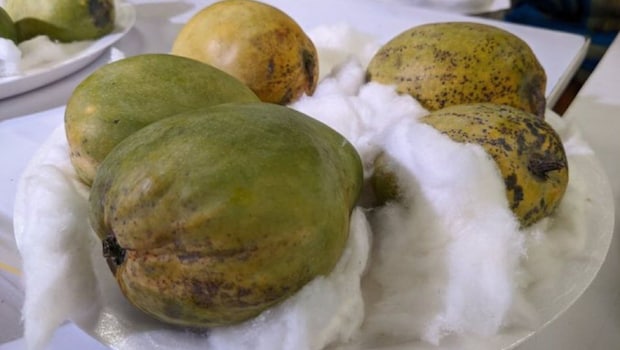
In his post, Goenka talks about the Kohitur as a mango that has “always been out of reach for most people,” describing it as an old, premium variety linked closely to Murshidabad's royal past. He points out that the mango is not just expensive, priced at around ₹1,500 or even higher for a single fruit, but is treated almost like a fragile artefact. According to him, each mango is “handled like a piece of glass,” carefully cushioned in cotton wool to protect its delicate skin.
He also highlights its exclusivity, noting that only a very small quantity is harvested every year, which adds to the sense of rarity. While sharing the post, Goenka even hinted at its almost unattainable nature, saying that it's a mango “you can't afford easily,” and that its treatment, history and price make it feel more like a luxury object than a seasonal fruit.
Watch the full post below:
Kohitur is an extremely rare, premium mango from West Bengal (Murshidabad) historically reserved for Nawabs, selling for approximately ₹1,500+ per piece. They are cushioned in cotton wool during handling to protect their fragile skin. pic.twitter.com/CCBwTahhf3— Harsh Goenka (@hvgoenka) February 27, 2026
In fact, when a user asked Goenka how many pieces he had of the Koithur mango, here replied, "can't afford."
Can't afford— Harsh Goenka (@hvgoenka) February 27, 2026
What Exactly Is A Kohitur Mango?
The Kohitur is often described as one of Bengal's most prized mangoes, with its origins tracing back to the time of Nawab Siraj‑ud‑Daulah. Historical accounts suggest that this variety was created by grafting some of the best mango saplings of the period, including the rare Kalopahar. What makes the Kohitur truly extraordinary is its limited availability. Only a handful of trees remain in Murshidabad, and in some years, the total harvest can be as low as 150 mangoes. This naturally keeps demand high among collectors and connoisseurs.
The mango's tender texture means it requires special care. Traditionally, it is never cut with a regular metal knife. Instead, a wooden knife is used to protect the fruit's purity and delicate flesh. Even hand warmth is believed to affect how it ripens, which is why growers shift the mango gently within cotton during storage.
Also Read: World's Largest McDonald's Opens At Disneyland Paris With A Three-Storey Play Area
Back in the Nawabi era, specialists known for their precise observation skills handled these orchards. Mangoes were nudged off branches using bamboo splinters rather than plucked with sickles, ensuring the stem wasn't bruised, as even a small nick was believed to alter flavour. Today, centuries later, the Kohitur still carries that old-world charm. It may not be widely grown or easily accessible, but for those who chase rare flavours and forgotten royal traditions, it remains one of India's most fascinating mangoes.
Have you heard about this mango before? Let us know in the comments below.