



It was thrilling to move to the West Coast after a childhood and adolescence spent well inland, deprived of the ocean's bounty.Fish for me during that period meant a tray of fish sticks, or frozen halibut steaks torched under the broiler. Of course, there was also canned tuna fish, as it was called, good for sandwiches or tuna casserole, that Midwestern stalwart. I did once have lobster tails at a tiki-torch Polynesian place in Cincinnati, but that was pretty much the extent of it.San Francisco, I presumed, would be filled with fishmongers. True, there were a few scattered throughout town, but back then there were really only two good choices for the freshest catch.
You could set the alarm clock for 4 a.m. and go down to one of the few fishing wharves left to buy straight from the source. The pier would be dark, foggy and quiet, and the work shift almost over. Gulls descended to score fish scraps, and if you were lucky, someone had hot coffee.
More fun (and more convenient) was a trip to Chinatown and the shops on Grant Avenue, all of which claimed to have the best seafaring creatures. But the old Dupont Market always attracted the largest crowds. Wooden boxes of live, grasping Dungeness crabs were displayed on the sidewalk. Over the cash register was this disclaimer: Live crab bite, dead crab no bite.The lively, noisy, smelly market always had carp in freshwater tanks and longneck clams, head-on wriggling gray shrimp and every bivalve you could want. You chose a fish, then watched as it was nonchalantly scaled and gutted in a flash.Now that I live in New York, Manhattan's Chinatown has become my new haunt. The other day, I was looking for a couple of whole fish to steam for dinner. Most shops had smallish black sea bass and red snapper, with the clear shiny eyes that gave proof of their freshness.
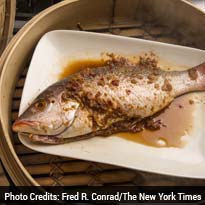
Steamed whole fish is underappreciated, but it is an excellent, fast way to cook fish at home. The fish, dabbed with ginger and a few other aromatics, is transformed in the process, reaching a sweet, near-melting succulence. The pan juices are the only sauce necessary.
A traditional bamboo steamer is great to have, but any sizable steamer will work, or you can rig up a steamer using a large pot. Make sure that the makeshift rack sits an inch or so above the boiling water, and that the pot has a lid. (Be careful when lifting the lid - steam is hotter than boiling water, and a blast of it can cause a severe scald.)The same method works for fish cut into boneless fillets or steaks; just shorten the cooking time. If you're not up to steaming, roast the fish for 15 minutes in a hot oven. But unless you are equipped with a turbocharged gas burner and a giant wok, go out to eat if you want crispy-fried whole fish. Some tasks are best left to a Chinatown restaurant kitchen.Steamed whole fish with ginger and sesameTime: 1 hour
Yield: 2 to 4 servings
2 whole fish, like black sea bass or red snapper, about 1 1/2 pounds each, gutted and scaled by a fishmongerSalt and pepper2 tablespoons Chinese sweet wine or dry sherry2 tablespoons soy sauce2 tablespoons grated ginger3 garlic cloves, minced1 tablespoon chili bean paste, available in a Chinese grocery1 teaspoon sesame oil, more for dressing2 teaspoons vegetable oil2 bunches scallions, cut in 3-inch lengths1 bunch cilantro1. Rinse fish with cold water, pat dry and season inside and out with salt and pepper. Place both fish on a heatproof platter or shallow baking dish. (Dish must be slightly smaller than inside dimensions of steamer.)2. Whisk together sweet wine, soy sauce, ginger, garlic, chili bean paste and 1 teaspoon sesame oil. Pour over fish and let marinate, turning once, for 30 minutes.3. Set up steamer with 3 inches of water in the bottom, then set rack 1 inch over water. Bring water to a rapid boil. Place fish, still on platter with marinade, on rack and cover with lid. (If using a bamboo steamer, cover top with a dish towel to retain steam.) Steam fish for 10 to 12 minutes, until just done. Flesh should look opaque, and there should be no pink at the bone when probed gently with a paring knife. Carefully remove platter from steamer.4. Meanwhile, place a skillet or wok over high heat and add vegetable oil. When oil looks hazy, add scallions and toss to coat. Sprinkle lightly with salt and stir-fry until slightly charred, about 2 minutes.5. To serve, scatter scallions over fish and top liberally with cilantro sprigs. (To make a tastier cilantro garnish, dress sprigs lightly with sesame oil and salt.) Using 2 forks, serve top fillet from carcass. Remove and discard skeleton to reveal lower fillet. Give each diner some fish, scallions and cilantro. Spoon pan juices over each serving.© 2013 New York Times News Service
You could set the alarm clock for 4 a.m. and go down to one of the few fishing wharves left to buy straight from the source. The pier would be dark, foggy and quiet, and the work shift almost over. Gulls descended to score fish scraps, and if you were lucky, someone had hot coffee.
More fun (and more convenient) was a trip to Chinatown and the shops on Grant Avenue, all of which claimed to have the best seafaring creatures. But the old Dupont Market always attracted the largest crowds. Wooden boxes of live, grasping Dungeness crabs were displayed on the sidewalk. Over the cash register was this disclaimer: Live crab bite, dead crab no bite.The lively, noisy, smelly market always had carp in freshwater tanks and longneck clams, head-on wriggling gray shrimp and every bivalve you could want. You chose a fish, then watched as it was nonchalantly scaled and gutted in a flash.Now that I live in New York, Manhattan's Chinatown has become my new haunt. The other day, I was looking for a couple of whole fish to steam for dinner. Most shops had smallish black sea bass and red snapper, with the clear shiny eyes that gave proof of their freshness.
Steamed whole fish is underappreciated, but it is an excellent, fast way to cook fish at home. The fish, dabbed with ginger and a few other aromatics, is transformed in the process, reaching a sweet, near-melting succulence. The pan juices are the only sauce necessary.
A traditional bamboo steamer is great to have, but any sizable steamer will work, or you can rig up a steamer using a large pot. Make sure that the makeshift rack sits an inch or so above the boiling water, and that the pot has a lid. (Be careful when lifting the lid - steam is hotter than boiling water, and a blast of it can cause a severe scald.)The same method works for fish cut into boneless fillets or steaks; just shorten the cooking time. If you're not up to steaming, roast the fish for 15 minutes in a hot oven. But unless you are equipped with a turbocharged gas burner and a giant wok, go out to eat if you want crispy-fried whole fish. Some tasks are best left to a Chinatown restaurant kitchen.Steamed whole fish with ginger and sesameTime: 1 hour
Yield: 2 to 4 servings
2 whole fish, like black sea bass or red snapper, about 1 1/2 pounds each, gutted and scaled by a fishmongerSalt and pepper2 tablespoons Chinese sweet wine or dry sherry2 tablespoons soy sauce2 tablespoons grated ginger3 garlic cloves, minced1 tablespoon chili bean paste, available in a Chinese grocery1 teaspoon sesame oil, more for dressing2 teaspoons vegetable oil2 bunches scallions, cut in 3-inch lengths1 bunch cilantro1. Rinse fish with cold water, pat dry and season inside and out with salt and pepper. Place both fish on a heatproof platter or shallow baking dish. (Dish must be slightly smaller than inside dimensions of steamer.)2. Whisk together sweet wine, soy sauce, ginger, garlic, chili bean paste and 1 teaspoon sesame oil. Pour over fish and let marinate, turning once, for 30 minutes.3. Set up steamer with 3 inches of water in the bottom, then set rack 1 inch over water. Bring water to a rapid boil. Place fish, still on platter with marinade, on rack and cover with lid. (If using a bamboo steamer, cover top with a dish towel to retain steam.) Steam fish for 10 to 12 minutes, until just done. Flesh should look opaque, and there should be no pink at the bone when probed gently with a paring knife. Carefully remove platter from steamer.4. Meanwhile, place a skillet or wok over high heat and add vegetable oil. When oil looks hazy, add scallions and toss to coat. Sprinkle lightly with salt and stir-fry until slightly charred, about 2 minutes.5. To serve, scatter scallions over fish and top liberally with cilantro sprigs. (To make a tastier cilantro garnish, dress sprigs lightly with sesame oil and salt.) Using 2 forks, serve top fillet from carcass. Remove and discard skeleton to reveal lower fillet. Give each diner some fish, scallions and cilantro. Spoon pan juices over each serving.© 2013 New York Times News Service
Advertisement