





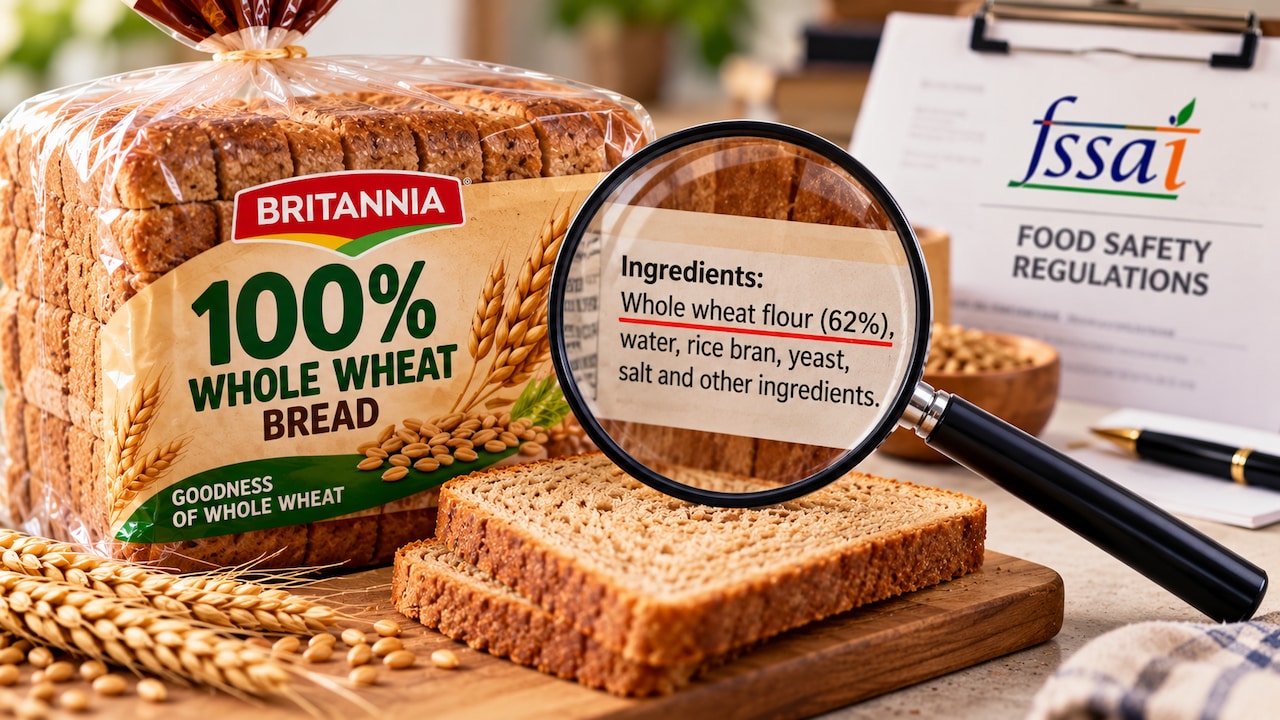
Buying brown bread or atta bread instead of white bread feels like a healthier choice. For many people, the words '100% whole wheat' on a packet are enough to make the decision. The assumption is simple: the bread is made entirely from whole wheat flour, contains no maida and is a better option for everyday meals.











But a recent order against Britannia Industries has raised questions about how such claims are used on food packaging, and what we as consumers should look for before buying bread.
The Central Consumer Protection Authority (CCPA) has imposed a penalty of Rs 1 lakh on Britannia for advertising its product as '100% Whole Wheat Bread' when its declared whole wheat flour content was only 62%. The authority has also directed the company to discontinue the advertisement across print, electronic and social media, and submit a compliance report within 15 days.
The issue is not simply whether a bread contains atta or maida. It is about whether the words on the front of the packet accurately represent what is inside it.
Why Was Britannia Fined Rs 1 Lakh?
The CCPA took up the matter after noticing that Britannia was promoting its bread as '100% Whole Wheat Bread', even though the product's declared whole wheat flour content was 62%.
According to the authority's order, the remaining 38% comprised other ingredients, including rice bran and other constituents. Britannia accepted during the investigation that the product contained 62% whole wheat flour, or atta.
The company reportedly argued that its claim referred to the wheat component of the bread. In other words, it maintained that the flour used was whole wheat flour rather than maida.
The CCPA held that an ordinary consumer seeing the words '100% Whole Wheat Bread' could reasonably understand them to mean that the product was entirely whole wheat, rather than that a particular component of the recipe was whole wheat flour.
READ | How The Latest Ban On Dabur Honey, Ghee, Oils With '100%' Claims Affects You
What Do FSSAI Rules Say About Whole Wheat Bread?
The Food Safety and Standards Authority of India (FSSAI) has specific requirements for the naming of different types of bread under the Food Safety and Standards (Labelling and Display) Regulations, 2020.
- Whole wheat bread: Whole wheat flour (atta) must constitute at least 75% of the flour used.
- Wheat bread or brown bread: Whole wheat flour must constitute at least 50% of the flour used.
- White bread: Refined wheat flour, or maida, is the specified flour ingredient.
- The loaf shall have a good volume/mass ratio of not less than 2.5. The crumb shall have small pores uniformly distributed, throughout and with thin cell walls.
- There shall be no hollow between the crust and the crumb
It is also important to understand what that percentage means. Flour is only one part of a bread recipe. Water, yeast, salt and other ingredients contribute to the finished loaf. Therefore, the percentage of whole wheat flour in the flour blend and the percentage of whole wheat flour in the finished product are two different measurements.
How Can You Check If Your Atta Bread Is Really Made With Whole Wheat Flour?

It is important to check the ingredients list while buying bread
You do not need to rely only on the name printed on the front of a bread packet. A closer look at the ingredient list and nutritional information can tell you much more.
1. Read the ingredient list, not just the front of the packet
Look for 'whole wheat flour' or 'whole wheat atta' in the ingredients list. Nutritionist Reema Arora says that ingredients are generally listed in descending order of weight, so those appearing near the beginning make up a larger proportion of the product.
If whole wheat flour is listed first, it is a useful indication that it is the main ingredient. If maida or refined wheat flour appears prominently, the bread may contain a substantial amount of refined flour.
However, ingredient order alone cannot establish the exact percentage of whole wheat flour in a loaf. For that, look for a quantitative declaration on the label, where available.
2. Check whether the bread contains maida
If you want to avoid maida, read the full ingredient list rather than relying on claims such as 'atta bread', 'brown bread' or 'whole wheat'. Check whether refined wheat flour or maida is also listed.
A 'zero maida' claim and a '100% whole wheat' claim are not interchangeable. The first concerns the absence of maida; the second can imply that the product is entirely whole wheat.
3. Understand what the bread's name guarantees
The regulatory standard requires whole wheat flour to account for at least 75% of the flour used in bread labelled 'Whole Wheat Bread'. The minimum for 'Wheat Bread' or 'Brown Bread' is 50% of the flour used.
That means brown bread is not automatically whole wheat bread, and whole wheat bread does not necessarily contain 100% whole wheat flour.
4. Look at the fibre content, but do not use it as the only test
Whole wheat flour retains the bran and germ of the wheat grain, along with the starchy endosperm. These parts contribute fibre and other nutrients.
Refined flour, by contrast, has had the bran and germ removed during processing. This is one reason whole grains are generally recommended as part of a balanced diet.
Also compare sodium, added sugar and serving sizes when choosing between brands. A bread containing whole wheat flour is not automatically the best option in every nutritional respect.
Do not judge bread by its colour
Brown bread may look healthier than white bread, but colour is not a reliable indicator of whole-grain content. That darker colour can come from ingredients such as molasses or caramel colouring.
Can Bread Ever Be '100% Atta'?
This is where the wording can become confusing.
If '100% atta' means that all the flour used in the recipe is whole wheat flour, the bread can still contain water, yeast, salt and other ingredients. It would not follow that the finished loaf consists entirely of atta.
But if a company advertises a product as '100% Whole Wheat Bread', consumers may reasonably interpret the claim as a statement about the whole product.
There is also a regulatory issue. FSSAI's May 2025 advisory asked food businesses to avoid using '100%' claims because the term is undefined and may mislead consumers. So even when a company intends to describe the flour component alone, it needs to ensure that its wording complies with the applicable rules and does not create a false impression.
If you want whole wheat bread, look for the whole wheat flour declaration, check whether maida is included, compare the nutritional information and remember that the legal minimum for bread labelled 'Whole Wheat Bread' is 75% whole wheat flour in the flour component.
About Neha GroverLove for reading roused her writing instincts. Neha is guilty of having a deep-set fixation with anything caffeinated. When she is not pouring out her nest of thoughts onto the screen, you can see her reading while sipping on coffee.