





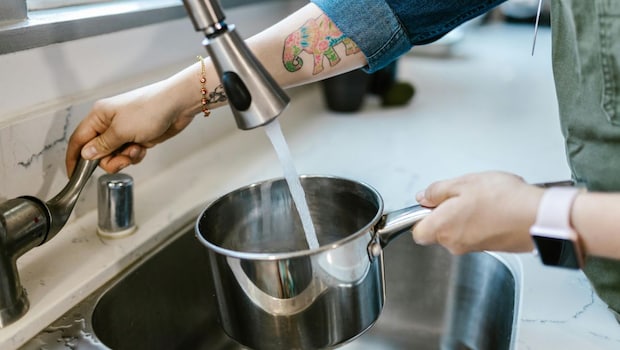
In most kitchens, using tap water for cooking is a given. We fill pots for boiling pasta and cook rice and lentils. Many people assume that as long as the water looks clear and is heated while cooking, it must be safe. But experts say the reality is more complicated. Boiling water does kill bacteria and viruses, but does it remove chemical contaminants that may be present in tap water?
Does Boiling Make Tap Water Safe?
One of the most widely believed kitchen myths is that boiling water makes it completely safe.
It is true that dangerous microorganisms like bacteria, viruses, and parasites can be killed by heat. However, boiling does not eliminate dissolved substances.
According to Encyclopaedia Britannica, heating water can destroy microbes, but many contaminants like heavy metals and salts remain in the water even after boiling. These contaminants may include substances such as lead, arsenic, fluoride, nitrates, and industrial chemicals.
Dr Anil Kumar, Chief Water Scientist at Eureka Forbes, also points out this common misunderstanding. He says, “There's a common misconception that boiling water makes it safe. While heat is effective against bacteria and viruses, it does not remove chemical contaminants.” This means water that looks clear and is boiled during cooking may still carry dissolved substances that heat cannot eliminate.
Boiling Water Can Actually Increase Some Contaminants
Another surprising fact is that boiling water can sometimes increase the concentration of certain substances. Dr Kumar explains that when water boils, some of it evaporates into steam, but dissolved chemicals stay behind. As the water level reduces, these substances become more concentrated in the remaining liquid. The U.S. Environmental Protection Agency (EPA) also claims that because hot water dissolves lead more quickly than cold water, it is more likely to contain higher levels of lead.
Also Read: 'Extremely Spicy Taco' Burns Man's Tongue, He Sues New York Restaurant
Microplastics Are An Emerging Concern

Photo: Pexels
In recent years, scientists have also begun detecting microplastics in drinking water. These tiny plastic particles are extremely small and cannot be seen by the naked eye. Dr Kumar highlights the concern and says, “Studies show the presence of microplastics in drinking water—particles linked to long-term health impacts that are invisible to the naked eye and undetectable through taste or smell.”
But does that mean one careless instance of boiling your rice in tap water will lead to harm? Certainly not. Experts highlight that the risk from contaminated water often comes from long-term exposure. When small amounts of contaminants are consumed repeatedly through food and water, over time, they can accumulate in the body. Dr Kumar summarises it simply, “The risk here is not in a single meal but in repetition.”
Also Read: No Cake Flour, No Problem: Chef Shows How You Can Make 4 Types Of Flours At Home
We're always prompt in investing in water filters for drinking water but continue using unfiltered tap water for cooking. Well, if water is filtered to remove contaminants before drinking, the same logic should apply to cooking as well. As Dr Kumar puts it, “Cooking water should be treated as part of daily nutrition, not just a utility, because whatever it carries becomes a part of what the body absorbs over time.”
For the longest time, we have all assumed that clear water and heat are enough to ensure safety. But as the challenges with water quality evolve, these assumptions may need reconsideration.