





Tea is woven deeply into everyday life in India, consumed across regions, incomes, and age groups, often multiple times a day. Its widespread popularity, however, also makes it vulnerable to quality compromises. Unlike many packaged foods, tea (especially loose tea) relies heavily on visual cues such as colour, granule size, etc. - all of which can be manipulated. Over the years, concerns around adulterated tea have periodically surfaced. To help buyers make more informed choices, the Food Safety and Standards Authority of India (FSSAI) has shared two simple at-home checks that can flag common forms of adulteration. These tests can encourage a more questioning approach to what often ends up in the daily cup.
Why Tea Is Prone To Adulteration
Photo Credit: Unsplash
Tea leaves vary widely in quality depending on origin, processing, and harvest season. Lower-grade tea often lacks strong colour, aroma, or weight. These are qualities that many consumers subconsciously associate with "good" tea.
To compensate, some sellers resort to adding:
- Artificial colouring to deepen the appearance of brewed tea
- Foreign particles to increase weight
- Recycled or exhausted tea leaves recoloured and resold
- Metallic contaminants, such as iron filings, that mimic the granular texture of tea
Loose tea sold unpackaged is especially vulnerable. Adulteration not only misleads consumers but can also pose health risks if contaminants accumulate over time.
Also Read: Food Authority Launches Crackdown On Adulterated Dairy Products: What Consumers Can Do
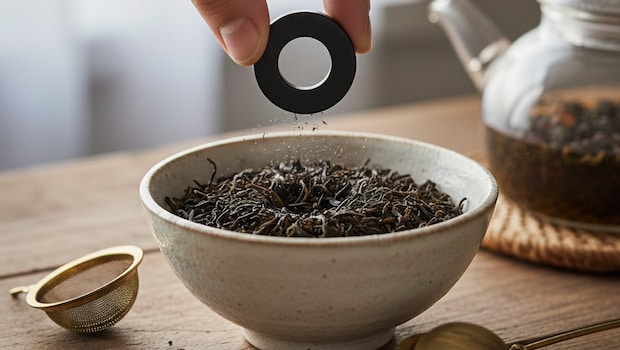
Magnet Test For Tea Adulteration: Checking For Iron Filings
One of the simplest tests suggested by FSSAI focuses on detecting iron filings, which are sometimes mixed into tea to increase weight or darken appearance.
How To Conduct The Test
- Spread a small amount of dry tea leaves on a flat plate or sheet of paper.
- Take a clean magnet and slowly move it over the tea leaves. Do not press the magnet into the tea; simply hover or lightly skim above the surface.
- Observe whether any particles are attracted to the magnet.
What The Results Mean
Pure tea leaves are non-magnetic, so they should not react. If small black or grey particles stick to the magnet, it suggests the presence of iron filings or metallic contamination. These particles often separate easily from the leaves when the magnet passes over them.
This test is effective for detecting one specific type of adulterant, but it cannot identify chemical dyes or reused tea leaves.
Filter Paper Test For Tea Adulteration: Detecting Artificial Colouring
The second method checks whether tea leaves have been treated with added dyes or colouring agents to enhance their visual appeal. The FSSAI suggests this test to check for Exhausted tea leaves, which refer to used tea leaves that are sometimes dried, re-coloured (often with synthetic dyes), and resold as fresh tea.
How To Conduct The Test
- Place a pinch of dry tea leaves on white filter paper, blotting paper, or plain tissue paper.
- Add a few drops of water directly onto the leaves.
- Wait for 30 seconds to one minute and observe the paper.
What The Results Mean
Natural tea releases colour gradually and usually requires hot water to brew properly. If the paper shows an immediate dark brown or black stain, spreading rapidly around the leaves, it may indicate added colour. Uneven or patchy staining is another potential red flag.
This test works best in bright light and on plain paper, where colour changes are easy to spot.
Also Read: 5 Easy Food Adulteration Tests You Can Perform At Home
What These Tests Can (And Cannot) Tell You
These checks are meant as consumer awareness tools, not definitive proof of adulteration. These are screening tests, not laboratory analyses. A negative result does not guarantee that the tea is completely pure. Some natural teas may release mild colour due to fine dust or processing variation.
These tests cannot detect pesticide residues, microbial contamination, or reused tea leaves with certainty. In other words, the tests help consumers identify obvious red flags, not subtle or chemical adulterants.
If adulteration is suspected, consumers are advised not to consume the product. Complaints can be lodged through official food safety channels. Repeated violations by sellers may lead to inspections and penalties. The regulator emphasises that food safety is a shared responsibility between authorities, sellers, and consumers.
Practical Tips For Consumers Buying Tea

While home tests are helpful, prevention begins at the point of purchase. Here are some practical ways to reduce risk:
1. Choose Packaging Wisely:
Opt for sealed, branded packs with FSSAI licence numbers. Avoid tea sold in open sacks without labelling or sourcing information.
2. Don't Judge By Colour Alone:
Very dark, glossy, or unnaturally uniform tea leaves can be a warning sign. Aroma and freshness matter more than colour intensity.
3. Be Wary Of Prices That Seem Too Low:
Exceptionally cheap tea often indicates compromised quality. High-quality tea requires labour-intensive processing, which is reflected in cost.
4. Store Tea Properly:
Poor storage can worsen contamination risks. Keep tea away from moisture, strong odours, and metal containers that may corrode.
5. Use Home Tests Occasionally:
Especially useful when buying from new or unfamiliar sources. Treat them as a precaution, not a guarantee.
Tea adulteration is not always visible to the naked eye, but simple awareness can go a long way in protecting consumers. The magnet and filter paper tests highlighted by FSSAI serve as easy first-line checks, helping people question quality rather than accept it blindly. While these methods do not replace laboratory testing, they empower everyday tea drinkers to make safer, more informed choices.