



There's something universally satisfying about the moment a dosa hits a hot tawa: the quick sizzle, the gentle spread of batter, and the anticipation of that golden, lacy crispness. While most of us treat dosa-making as a practised instinct, the process is guided by a surprisingly elegant set of scientific principles. Temperature, evaporation, and surface behaviour all play quiet but crucial roles in determining whether your dosa turns out crisp, patchy, or disappointingly soft. Home cooks often rely on sensory cues like a splash of water, the sound of the pan, the way the batter moves, etc., without realising that these are rooted in well-established physical phenomena. Understanding the science behind these everyday gestures reveals why the simplest methods, perfected over generations, work so consistently. And it turns the humble dosa into a fascinating study of physics meeting food.
The Phenomenon Behind Crispy Dosas
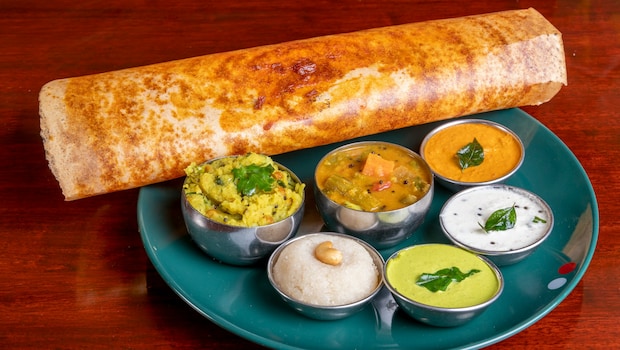
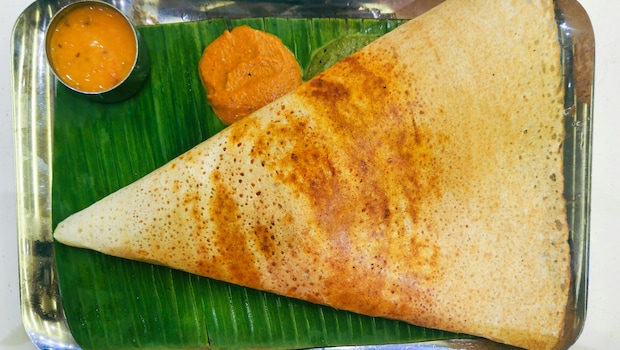
Crispy Dosa. Photo Credit: Unsplash
A recent post shared by the official X account of IIT Madras offers a useful insight into how dosas can be made well. The now-viral post refers to an authored article by Prof. Mahesh Panchagnula. He explains how the art of getting a dosa "perfectly crispy on the outside and soft inside" has as much to do with physics as with culinary instinct. The professor noted that the common habit of sprinkling water on a hot tawa is essentially a temperature test based on the Leidenfrost Effect. This is a concept formally identified in 18th-century Germany but long practised intuitively in Indian homes.
Also Read: 5 Hacks That Will Keep Your Dosa Batter Fresh and Delicious
What Exactly Is The Leidenfrost Effect?
The Leidenfrost effect is a simple but fascinating bit of everyday science. When a surface becomes extremely hot, any water that touches it doesn't immediately sizzle and evaporate. Instead, the water forms a thin cushion of vapour underneath it. This vapour layer keeps the droplet from touching the hot surface directly, so the droplet skates around and appears to "dance" rather than vanish on the spot. You'll see this when you sprinkle water on a very hot tawa: instead of drying instantly, the droplets glide smoothly across it. Essentially, the surface is so hot that it creates its own protective steam layer, letting water move freely until it finally evaporates.
Also Read: How To Make Crispy Dosa Without A Cast Iron Pan
How The Textures Of Dosas Are Determined By The Leidenfrost Effect
Dosa making tip: Wait for the tawa to get heated properly. Photo Credit: Unsplash
The viral post by IIT Madras notes that, when the pan is not hot enough, the water "just sits there and evaporates slowly." If you add the batter at this point, it will become lumpy and not spread well. It may also lead to the dosa breaking apart later. However, at the ideal temperature, the water droplets begin to skim across the surface, as explained above. This same effect keeps the batter from sticking, helps it spread smoothly, and ultimately lets the dosa crisp at the edges.
Ever wondered why a dosa turns out perfectly crispy on the outside and soft inside? The secret goes far beyond culinary instinct driven by physics.
In an authored article for @dt_next@iitmadras, Prof. Mahesh Panchagnula unpacks the science behind this everyday magic. The… pic.twitter.com/ZaiyFjJ6o6— IIT Madras (@iitmadras) November 27, 2025
Here's how X users reacted to this viral post:
Amazing how instinct and science meet on a hot tawa. Truly enjoyed this.— Cherag Jhaveri (@JhaveriCherag) November 28, 2025
Seriously! This is a revelation indeed!👍— sharing is caring!🍀🇮🇳 (@physiomayuri03) November 28, 2025
Physics and Chemistry exist in everything in day to day life, as they form the cornerstone of what we see around us. Individual skill, here Culinary instinct decides when to pour the batter on the griddle and get a crispy dosa. Not just physics…need to complement it with skills— Dr. K (@dr_kris_uvacha) November 28, 2025
The article prompts us to see the science in everyday phenomena that one may hardly pause to think and enjoy.
Dosas and such Indian or other eateries, often are blend of art and science. It's a pleasure to enjoy the culinary as well as the Art and the Science. Enjoy!! That's it— FCRI-India (@FlowResearchInd) November 29, 2025
Dosalogy, a new discipline, served hot by IIT M!— Radha Konda (@Konda_Radha) November 27, 2025
Interesting read! Never thought of the physics of crispy dosa when ruining it on the pan. 😁— Umesh | Built to Better 🌿 (@BuiltToBetter) November 28, 2025
Wow.. that's amazing to know.. Dosa has always been a delightful part of our cuisine 🙂— The Wholistic Health Collective (@TheWholisticDr) November 28, 2025
The science behind a crispy dosa shows that great cooking isn't just about recipes but about recognising how heat, moisture, and movement interact on a hot surface. By appreciating the principles at play, from temperature checks to vapour dynamics, we gain a deeper respect for a dish that looks simple but is anything but. Understanding the "why" behind the process ultimately makes every dosa feel even more rewarding.