




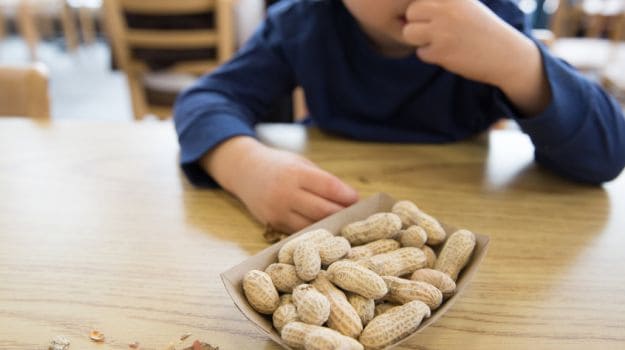
You may have ignored the symtoms as flu or common cold but a child we frequently sneezes or coughs a lot, often develops rash or hives and gets stomach stomach ache may be allergic to certain foods.
"Our work shows food tolerance is acquired and involves specific populations of T cells that develop following its consumption. Without them, we would mount a strong immune response to macromolecules contained in food," Surh added.This is one of the first studies to demonstrate that consumption of a normal diet stimulates cells in the gut that suppress rejection of food by the immune system. The research was published online in issue of Science and it explains how food tolerance emerges over time in normal individuals.Like pathogens, food displays macromolecular markers known as antigens that announce to the immune system that food is "foreign". For the study, researchers conducted "antigen-free" mouse models, these animals were not only raised in a germ-free environment. Antigen-free mice were depleted of Tregs in the small intestine whereas a large number of these Tregs were present in germ-free counterparts, the study found. Interestingly, germ-free mice are known to be highly susceptible to allergies.The team explained that proteins contained in food stimulate the development of Treg cells. It also hints at the fact that Tregs present in the gut of normal mice might suppress a potentially disastrous immune response to those proteins. Hence, the presence of both food-and microbe-induced populations of Tregs is required to prevent allergic symptoms. In simple terms, consumption of a normal diet stimulates cells in the gut that suppress rejection of food by the immune system which is why some children are more prone to develop allergies. This study explains what happens on a cellular basis as some children outgrow it - they may be expanding their repertoire of Tregs that recognise new foods as 'safe'.With inputs from IANS

 Should Machines Decide Who Lives And Dies In A War? Ex-CIA Chief Answers
 Kriti Sanon Says Instagram Has No Option To Report AI-Generated Images Of Her
 What Anthropic, Monks And The Cusp Of Consciousness Teach About Tomorrow
 Nikhil Kamath's Big AI Bet: Why India Should Look Beyond Silicon Valley
 When Will India Get Its Own Apple, Samsung? Ashwini Vaishnaw Reveals Timeline
 Neeru Saini On Fitness, Focus & Her Love for Churma!
 NDTV Lifeline- Himanshu Saini on the Secret to Eating Well: More Greens, Healthier Desserts
 Hockey Champions Savita Punia & Neha Goel on Fitness, Recovery & The Meaning of Health
 Millets: The Superfood That's Good for You and the Planet
 Yoga, Millets, Vaccines: S Jaishankar On How India Is Building Stronger Ties | NDTV World Summit
"Our work shows food tolerance is acquired and involves specific populations of T cells that develop following its consumption. Without them, we would mount a strong immune response to macromolecules contained in food," Surh added.This is one of the first studies to demonstrate that consumption of a normal diet stimulates cells in the gut that suppress rejection of food by the immune system. The research was published online in issue of Science and it explains how food tolerance emerges over time in normal individuals.Like pathogens, food displays macromolecular markers known as antigens that announce to the immune system that food is "foreign". For the study, researchers conducted "antigen-free" mouse models, these animals were not only raised in a germ-free environment. Antigen-free mice were depleted of Tregs in the small intestine whereas a large number of these Tregs were present in germ-free counterparts, the study found. Interestingly, germ-free mice are known to be highly susceptible to allergies.The team explained that proteins contained in food stimulate the development of Treg cells. It also hints at the fact that Tregs present in the gut of normal mice might suppress a potentially disastrous immune response to those proteins. Hence, the presence of both food-and microbe-induced populations of Tregs is required to prevent allergic symptoms. In simple terms, consumption of a normal diet stimulates cells in the gut that suppress rejection of food by the immune system which is why some children are more prone to develop allergies. This study explains what happens on a cellular basis as some children outgrow it - they may be expanding their repertoire of Tregs that recognise new foods as 'safe'.With inputs from IANS