



Dal is a staple food in many Indian households. Different types of these lentils are used to make a wide variety of everyday dishes. While dal is well-known as a wholesome, nutrient-rich ingredient, some people avoid consuming it due to bloating concerns or digestive discomfort. But have you ever wondered why dal causes problems for some people? There are many misconceptions about the same. Dr Jayesh Sharma, a Raipur-based oncologist, recently posted an Instagram video debunking some of these myths. He began by explaining the "foamy" layer we see forming on top of cooked dal, and went on to describe the best way to handle it.
What Is The Foamy Substance Formed While Cooking Dal?
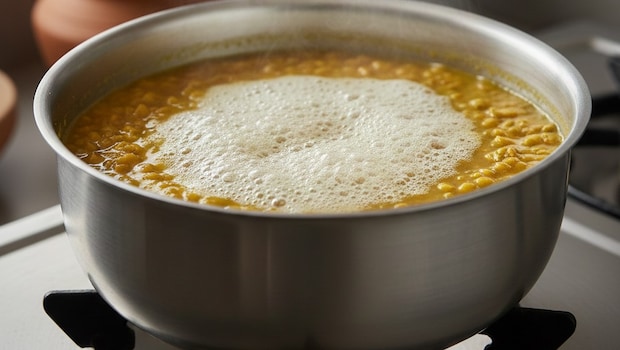
When you cook dal, you may notice a pale, frothy layer forming on the surface as it boils. This foam is completely natural and is mainly caused by proteins and starches released from the lentils when they come into contact with hot water. Lentils are rich in plant proteins. As the dal heats up, these proteins change structure and trap air, forming bubbles that rise to the top. At the same time, surface starch loosens from the lentils, adding thickness to the foam.
Also Read: 5 Dal Cooking Mistakes That Are Ruining Your Meal
Is The "Foam" Released While Cooked Dal Harmful?
Dr Jayesh Sharma claims that many people believe the foam is "poisonous," but this is far from true. Apart from starch and protein, he points out that this foam contains saponins, a compound that functions as the plant's "defence mechanism." The doctor says that this compound has anti-inflammatory and anti-cholesterol properties when consumed in small quantities. However, too much of the foam can make the dal bitter and consuming it in large amounts could damage gut lining. People with IBS (irritable bowel syndrome) may face issues with even regular quantities of saponins, notes the medical expert. He then goes on to reveal why some people feel bloated after eating dal. According to him, the main cause for this is FODMAPs.
What Are FODMAPs?
FODMAPs are a group of short-chain carbohydrates that are poorly absorbed in the small intestine. The term stands for:
- Fermentable
- Oligosaccharides (like fructans and GOS)
- Disaccharides (like lactose)
- Monosaccharides (excess fructose)
- And
- Polyols (like sorbitol and mannitol)
When these carbs aren't properly absorbed, they travel to the large intestine, where gut bacteria ferment them. This fermentation can cause gas, bloating, stomach pain, and discomfort, especially in people with sensitive digestion or IBS.
Dal (lentils and pulses) is naturally rich in GOS (galacto-oligosaccharides), a type of FODMAP. Humans don't produce enough of the enzyme needed to fully break these down, so they often reach the gut intact and ferment. This is why dal can sometimes cause bloating, gas, and/or a feeling of heaviness after meals.
Importantly, this doesn't mean dal is "bad". It's just harder to digest for some people, especially in large quantities or when undercooked.
How To Make Dal More Digestible?
Dr Jayesh states that pressure cooking dal is the best way to break down FODMAPs and saponins, due to the high temperature it uses. According to him, more than removing the "foamy layer" on top of dal, soaking it properly, washing it well and cooking it thoroughly are essential if you want to avoid bloating.
Why Is Soaking Dal Important?
When you soak dal and discard the soaking water, some of the FODMAPs leach out, lowering the chances of bloating and gas. Soaking also loosens excess starch and dust from processing. This is why soaked dal cooks cleaner, foams less, and tastes lighter compared to unsoaked dal.
Why Pressure Cooking Dal Is Good For You
Pressure cooking is faster and uses less water, which means that fewer water-soluble nutrients are lost compared to long open-pot boiling. Soaking prepares the dal by reducing problem compounds, while pressure cooking finishes the job by fully softening fibres and proteins. This is why dal that is both soaked and pressure-cooked feels lighter after eating, causes less bloating (potentially), and has better flavour and consistency.
Also Read: 5 Pressure Cooker Mistakes That Are Ruining Your Dishes
In conclusion, if dal ever feels heavy on your stomach, the issue is rarely the dal itself. It's usually insufficient soaking, undercooking, or oversized portions. A simple soak (20-40 minutes) followed by proper pressure cooking can dramatically improve how your body handles it, which explains why these methods have stood the test of time in Indian kitchens.